Quick Answer
To confirm piston ring sizes, match the intended cylinder bore and the piston’s ring grooves, then agree what each supplied set contains. Keep the engine code, piston reference, bore designation and original measurement units together. “Standard” or “oversize” alone is insufficient. Final selection and clearance checks must follow the applicable engine, piston and ring manufacturer’s information.
A quotation reading “piston rings, standard size, one set” leaves several decisions unresolved. Which piston does it match? Has the cylinder been machined? Does the price cover one piston or the complete engine? Resolve those questions before comparing prices or sending a purchase order.
Start with the bore and the actual piston
The engine code identifies the starting application. It does not describe every change made during a previous repair. Ask for the piston maker’s reference, any readable size marking and the workshop’s record of the cylinder condition.
Hastings explains that a cylinder may have been machined oversize. Its guidance calls for checking cylinder size before installing rings. For purchasing, the useful evidence is an identified bore record from the responsible workshop, including units and whether machining is complete. A photograph of the piston crown can support identification, but it does not establish the current bore dimensions.
Keep the catalog bore designation separate from the workshop’s measurements. If a supplier quotes an oversize, ask for the complete designation, its units and the piston reference it matches. Do not turn an isolated marking into an assumed finished bore or silently convert a rounded figure into an order specification.
If further machining is planned, ask the workshop when it can confirm the final specification. A preliminary quotation can remain useful, but its size should be marked as awaiting confirmation. Avoid releasing the final order while the buyer, machinist and supplier are still referring to different bore conditions.
Diameter is only one part of the match
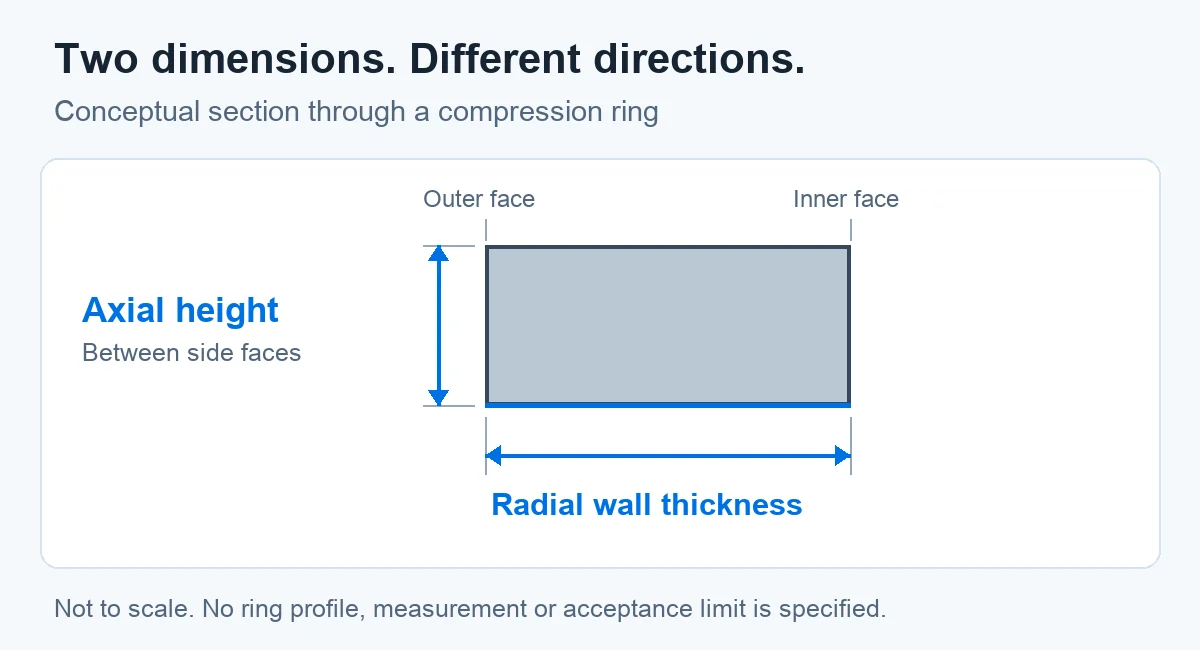
A ring must also suit its position in the piston. MAHLE’s ring terminology distinguishes axial height, radial wall thickness and end gap. These describe different features; none should be substituted for another in a quotation.
| Information | What the buyer should clarify |
|---|---|
| Bore designation | The intended cylinder size and its standard or oversize designation, with units. |
| Axial height | The ring’s height between its side faces, identified for each ring position. |
| Radial wall thickness | The ring’s thickness from its outer running face toward its inner face. |
| Installed end gap | A separate clearance check under the applicable instructions; it is not the ring’s axial height. |
When a catalog shows a sequence of ring heights, retain its order and the manufacturer’s explanation of the positions. A cropped label without the part number or units may remove the information needed to interpret it. Request a complete label photograph and the matching catalog entry.
Hastings also notes that some engine models have both deep-groove and shallow-groove piston versions. That is why a matching engine model alone may leave an important piston detail unresolved. Ask the ring supplier to confirm the intended piston version rather than choosing whichever set shares the most familiar engine name.
This is an identification task, not a recommendation to measure every feature with one tool. If the piston reference is missing, the workshop and component supplier should determine what measurements and documentation are needed. Do not approve a substitute from visual similarity alone.
Define what “one set” includes
Write the coverage into the quotation. Ask whether the offered quantity supplies one piston, a stated number of cylinders or the complete engine. Then list the required ring positions and the packaging quantity. “Four sets” has little commercial meaning until both parties use the same unit.
MAHLE distinguishes individual oil-ring components from assemblies. Counting loose pieces in a photograph can therefore be misleading. Have the supplier identify the assembly design and package contents using the relevant product reference. A picture remains useful for checking what is present, but it should accompany the written scope.
For distributor orders, keep each engine and piston reference on its own line. Record any agreed alternative separately. This makes it easier to compare offers and to investigate a shortage without confusing a different size with a missing quantity. The same principle applies when reviewing a replacement-engine purchase order.
Turn the information into a usable order line
Use a short record that travels with the quote, approval and packing list. Leave unknown fields open until someone responsible confirms them:
Engine code and application; piston maker/reference; bore designation and units; machining status; ring dimensions by position; ring-set manufacturer/reference; coverage per package; package quantity; supporting photographs or documents.
The buyer confirms the application and required quantity. The workshop confirms the relevant engine condition and measurements. The supplier confirms the offered reference, intended application and package contents. Keep those responsibilities visible instead of treating a purchase approval as a substitute for technical confirmation.
Before dispatch, request photographs of the actual product labels against the approved order line. On arrival, compare the delivered references, size designations and quantities before opening or mixing packages. Our receiving-inspection guide explains the broader documentation process.
How can NANXI POWER support the wider engine decision?
If the repair assessment also leads to a replacement-engine inquiry, NANXI POWER can help review the engine code and original-unit photographs, confirm the requested product form, and discuss available pre-shipment visual records. Read the engine assembly scope comparison before choosing the form. These capabilities support an engine quotation; they do not establish ring-set availability, a machining service or a fitment guarantee. Any separate component request needs product-specific confirmation.
Keep the installation decision with the applicable instructions
Correctly describing piston ring sizes is an ordering step. It does not establish that a worn cylinder or piston can be reused. Inspection limits, bore preparation, ring orientation and installation clearances depend on the actual components and their instructions. This article supplies no universal clearance, machining allowance or installation procedure.
The cover is an illustrative edit of a public-domain two-ring piston photograph. It is not a NANXI product photograph, a dimensional record or a claimed application for the parts discussed.
Manufacturer references
- Hastings: Oversize Cylinders — cylinder condition and size verification; numerical instructions are not generalized here.
- Hastings: Ring Groove Depths of Piston Rings — piston/ring matching and deep- versus shallow-groove variants.
- MAHLE: Piston Rings, PR-40-22, terminology on printed pages 11 and 16 — dimension and assembly definitions; performance recommendations are not transferred to other engines.
Discuss your engine requirement
For an engine or engine-assembly inquiry, send the engine code, original photographs, required product form, quantity and delivery country. NANXI POWER can review those details before discussing the specific quotation.