Quick Answer
Engine part number supersession is a catalog relationship to verify, not proof that two quoted engines are interchangeable. Before approving a different reference, confirm the old-to-current number chain in the applicable manufacturer catalog, match the catalog entry to the intended vehicle or engine, and compare the exact assembly scope in the quote. Record the source and get any remaining application or configuration difference confirmed in writing.
If an engine quotation lists a different OE reference from your old invoice or original engine record, do not approve or reject it based on the suffix alone. Engine part number supersession needs to be checked against the source catalog, the specific application and the assembly being offered.
What Does “Superseded” Mean in an Engine Parts Catalog?
A catalog may show that a later service number replaces an earlier reference. That is useful evidence about the catalog’s numbering relationship. It does not, by itself, tell a buyer whether a particular aftermarket unit, regional vehicle variant or differently equipped engine is the correct order for their case.
Official listings show why the full entry matters. The official Nissan Parts Store lists a complete engine assembly, a 1999–2001 Nissan Maxima application, the VQ30DE engine, and a superseded number on the same listing. The official Mopar eStore lists long-block number 68565534AB as replacing 68565534AA and names components that this long block does not include. These are examples for their stated products and markets; they are not cross-brand fitment rules.
Also separate an orderable service number from markings found on a physical engine. A casting, engineering or production mark may be useful identification evidence, but it should not automatically be treated as the current catalog number. For that distinction, see the guide to engine code versus engine number.
Make Three Checks Before You Accept the New Number
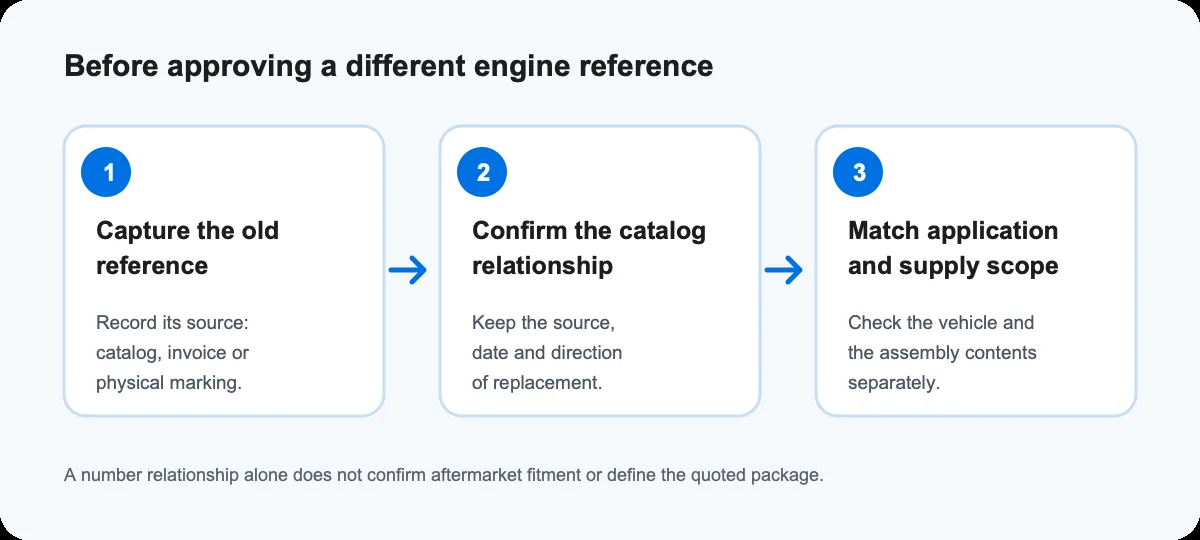
- Confirm the number relationship. Search the applicable manufacturer parts catalog or ask its parts department to confirm the old reference, current orderable number and direction of the replacement. Save the catalog page, dated quotation or written confirmation. A seller-created cross-reference can help start a discussion, but it is not the same as an OEM catalog record.
- Confirm the application. Use the VIN when a manufacturer catalog supports it, then check its stated model, production range, engine, transmission or other applicable notes. Ford’s official parts site recommends VIN search for more accurate parts results. VIN decoding still needs to be checked against the catalog’s market and vehicle details; it is not a universal approval for an aftermarket assembly.
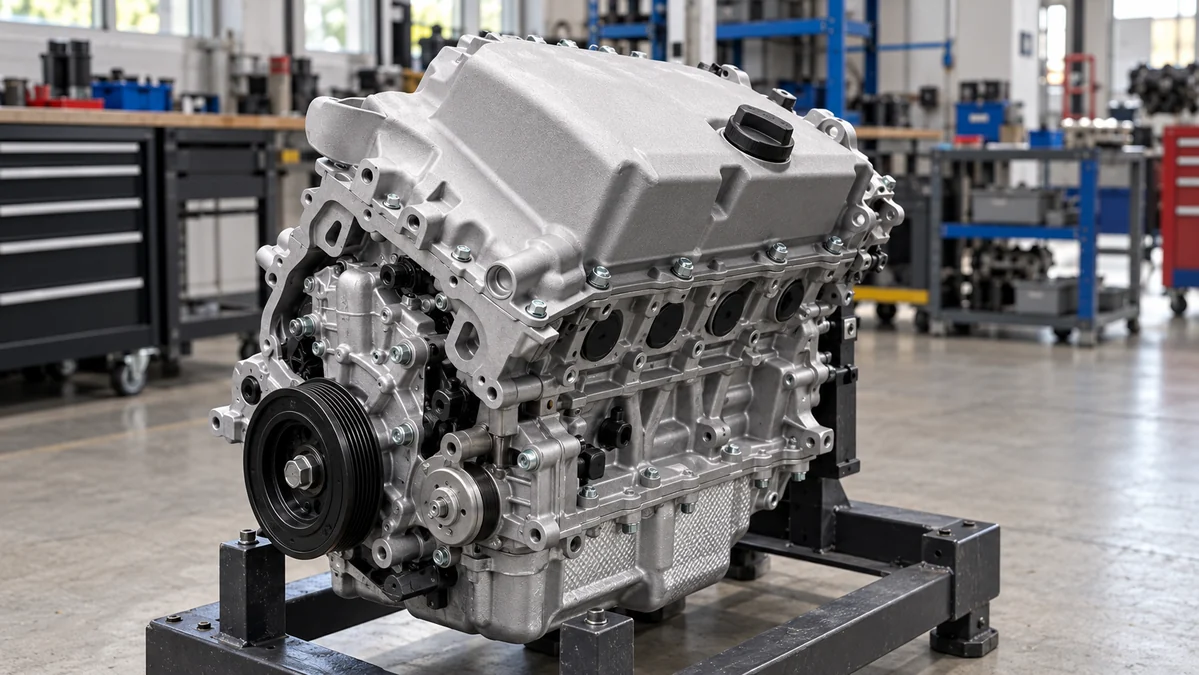
- Confirm the supplied scope. Establish whether the quote is for a complete engine, long block, short block or another defined form. Compare included accessories and exclusions instead of assuming the later number describes the same package. The replacement-engine listing checklist and configuration guide cover those product-scope questions.
Keep a Short Supersession Record With the Order
For a single replacement, attach the catalog evidence to the quotation and state the old and current references on the same line. For a distributor’s multi-model purchase, keep one row per engine application; do not reuse one confirmation across all vehicles sharing a similar model name.
- Customer’s original engine or OE reference and its source.
- Manufacturer catalog or parts-department confirmation, including the check date.
- Vehicle or engine identifiers used for the application check, with personal information handled under your normal privacy rules.
- Quoted number, exact product form, accessory scope and any accepted differences.
- Name of the person who approved the substitution and the related order revision.
If the catalog does not show the relationship clearly, keep the quote pending and ask for a written answer from a suitable parts source. Do not infer interchangeability from similar digits, a shared engine family name or a seller’s unqualified “replacement” label. The broader engine quotation checklist helps keep the agreed product form and commercial terms together.
What to Ask the Supplier Before Approval
A concise written question is easier to verify than “Will this fit?” Ask for the catalog source behind the replacement number and state which engine or vehicle details were checked. Then ask for the exact quoted assembly contents. If the catalog covers one market or production range, keep that limit with the quote.
For an aftermarket assembly, request the seller’s own product description and configuration evidence as a separate record. Manufacturer catalog supersession and the seller’s supply specification answer related but different questions. Do not present a catalog number as proof of a NANXI POWER product’s part identity unless the actual item and its documentation have been checked.
Frequently Asked Questions
Does a superseded number always mean the newer engine fits?
No. It documents a catalog relationship for the listed manufacturer’s part and application. Confirm the intended vehicle or engine and the quoted assembly separately.
Is the suffix the only difference buyers need to check?
No. Check the full number, catalog direction, application notes, market, product form and included scope. Similar-looking number endings are not a cross-reference method.
What if a manufacturer’s online catalog has no fitment details?
Use the catalog’s stated contact route or a qualified parts source and provide the VIN, engine identification and the complete old reference. Keep the order open until the application is answered in writing.
How Can NANXI POWER Help Review an Engine Reference?
NANXI POWER can review the engine code, VIN and original engine photos you provide, then clarify the requested product form and included configuration before quotation. Send both the earlier reference and the proposed replacement number, along with the vehicle market and required quantity. The team can help identify questions that need confirmation in the source catalog or supply record; this review is not a universal fitment guarantee.
References and scope
- Official Nissan Parts Store: Engine Complete Assembly 10102-2Y9A6 — listing shows a superseded number and an application description for that Nissan entry.
- Official Mopar eStore: Long Block Engine 68565534AB — listing shows the earlier number it replaces and states exclusions for this long-block.
- Ford Parts: Find the Right Part — recommends VIN search for more accurate part searches on its U.S. site.
These manufacturer or official parts-store examples support how buyers can inspect catalog fields. They do not establish a cross-brand rule or confirm fitment outside each entry’s stated scope.
Need a Quote Checked Against Your Reference?
Send the old and proposed number, engine code or VIN, original engine photos, requested assembly form, quantity and delivery country. NANXI POWER can help review the engine reference and configuration; ask for any unresolved difference to be confirmed in writing.
Official business channels