Quick Answer
A Mazda3 LF cold no-start needs a starting-behavior check before an engine order. Mazda documents a software-related winter starting condition for specified LF vehicles. The repair path depends on vehicle identity, stored fault codes and the response to a technician’s de-choke check. Record those findings before approving parts.
What happens when you try to start it?
Describe the sound and engine movement first. “Will not start” can mean silence, repeated clicks, slow rotation or normal cranking without combustion. Tell the workshop which behavior occurred and whether it changed between attempts. A short recording made from the driver’s seat can preserve a symptom that disappears before the vehicle arrives.
- Silence, clicking or slow cranking. Ask for the battery, connections and starting system to be assessed. Mazda identifies these as possible starting-system symptoms.
- Normal cranking without starting. Record whether this happens after an overnight cold soak, and whether the engine later starts normally.
- Unusually fast or uneven rotation. Report the change and arrange inspection before further attempts.
Mazda’s general starting guidance separates battery, connection, starter, fuel and engine concerns. A workshop can use the observed behavior to select its first tests. Mazda starting-symptom guidance
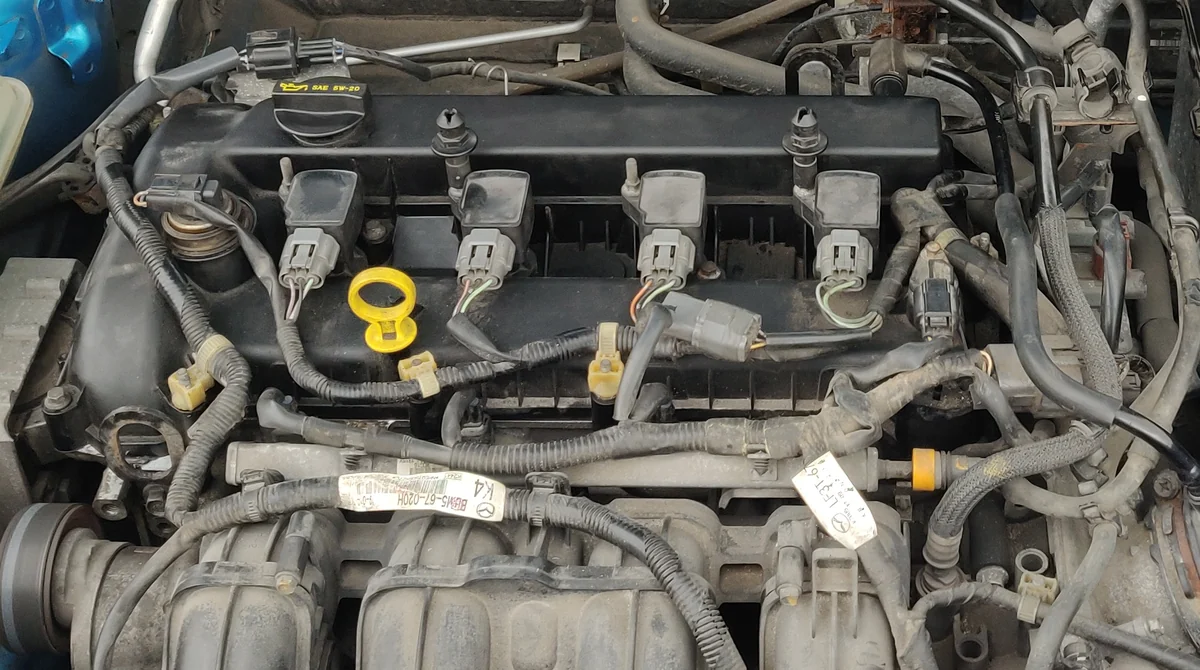
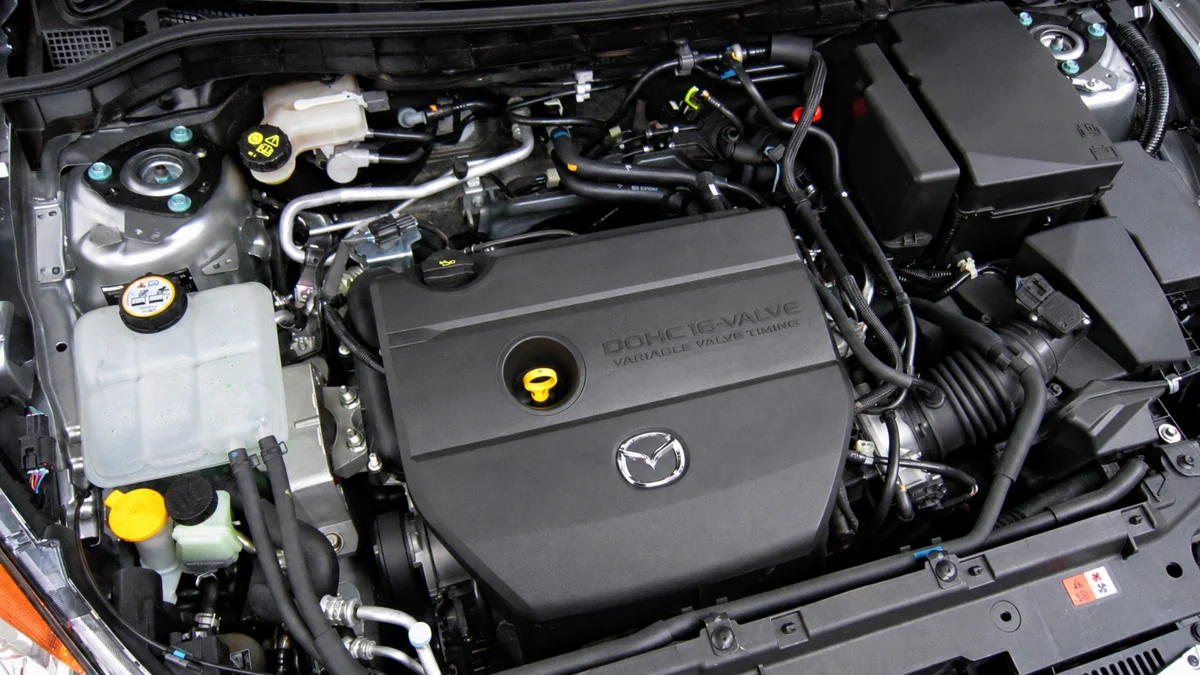
The exposed ignition-coil connectors in the photograph help identify the kind of electrical details worth recording after recent engine work. With the engine off, provide a clear photograph of the installed arrangement and tell the technician which connectors or accessories were disturbed. Our engine wiring connector guide explains how to make those photographs usable.
Which Mazda3 LF vehicles does the bulletin cover?
Match the emissions specification and VIN as well as the engine code. The October 9, 2013 revision of Mazda bulletin 01-005/13 includes 2010–2013 Mazda3 2.0L LF Federal-emissions vehicles below VIN JM1BL**F***768364, produced before December 17, 2012. Ask the workshop to confirm the actual vehicle against current Mazda service information. Keep a photograph of the vehicle’s emissions label with the VIN record. Mazda bulletin 01-005/13
The LF listing in a supplier catalogue establishes a product to discuss. The workshop still needs the installed engine identity and the vehicle’s control-system details. If the engine has been changed previously, send photographs of its identification marks together with the vehicle documents. See our engine code and engine number explanation.
How do fault codes and de-choke response change the next step?
The bulletin provides a conditional software-repair route. Mazda associates the specified winter condition with PCM control logic. PCM means the computer that manages the engine and related powertrain functions. The technician first checks for diagnostic trouble codes, usually shortened to DTCs, then follows the relevant branch.
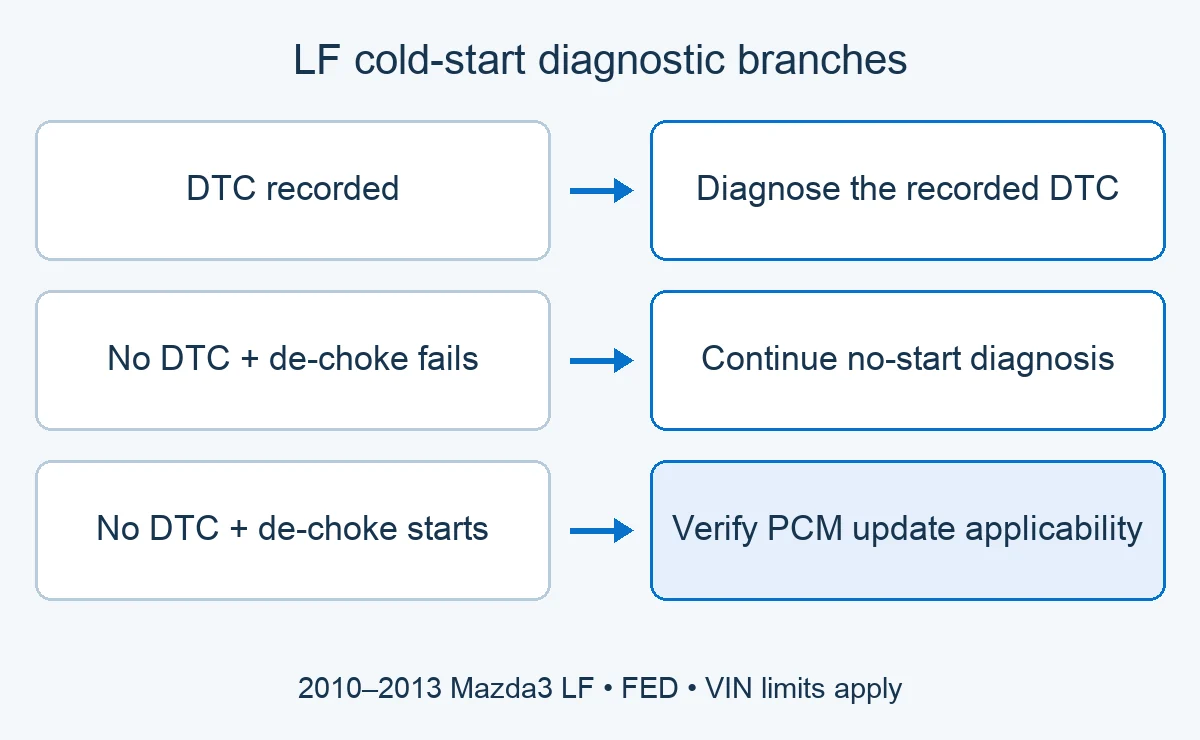
- A fault code is recorded. Diagnose it through the applicable workshop information.
- No code is recorded, and de-choke does not start the engine. Continue the workshop’s no-start diagnosis.
- No code is recorded, and de-choke starts the engine. Verify the bulletin’s PCM-reprogramming applicability.
De-choke is a controlled starting mode used to clear excess fuel. Ask the technician to record its result. Mazda’s owner manual gives starting instructions for the vehicle’s ignition equipment, while the service bulletin specifies its diagnostic sequence. Use the matching instructions and their attempt limits. 2010 Mazda3 owner manual, page 7-17
For the qualifying branch, the historical bulletin directs a software update and says a replacement PCM part is unnecessary for that procedure. The workshop should obtain the current vehicle-specific calibration through Mazda’s service system. Keep the installed calibration identification on the job sheet. Mazda bulletin 01-005/13
What should you give the workshop, and what should it return?
Keep the original complaint and the test results on one job record. An importer handling the enquiry remotely needs enough detail to understand how the workshop reached its recommendation. Ask for these items when opening the job.
- The VIN, engine identification, emissions-label photograph and transmission type.
- The date, approximate outside temperature and time parked before the failed start.
- A description or recording of the cranking behavior, plus any recent repairs or battery work.
- The scan report, including an explicit record when no DTC was found.
- The technician’s de-choke result and the applicable diagnostic branch.
After work, request the action taken, any calibration change and the final starting check. Mazda’s bulletin includes a start-and-warning-light verification after programming. If the original complaint occurred only after overnight parking, agree how the workshop will check that condition and record it separately from an immediate warm restart. Mazda bulletin 01-005/13
When should an engine quotation enter the discussion?
Base the quotation on a confirmed mechanical finding. Ask the workshop to identify the failed component, the evidence supporting that conclusion and the proposed repair. If it recommends an engine assembly, request the measurements or inspection findings behind that recommendation. Keep them with the original cold-start report.
Compare repair and replacement using the same scope. Include labor, the external components to be retained, and any separate electrical or control-system work identified during diagnosis. The repair-or-replace comparison can organize those figures. Before accepting a long-block offer, list the included and transferred parts on the quotation.
How NANXI POWER can support an LF enquiry
NANXI POWER can review the VIN, engine code and original-engine photographs, then help confirm the requested configuration and accessory scope. Send the workshop’s confirmed mechanical findings with that information when requesting a replacement proposal. This gives both sides a specific basis for comparing the required assembly with the existing installation.
These are current product pages. Confirm compatibility by VIN.
See the corresponding Mazda catalogue for product navigation.
Send the LF diagnosis with your enquiry
Contact NANXI POWER with the engine identity, diagnostic findings, required assembly, quantity and destination country. Use WhatsApp or Email, or enquire through Made-in-China and Alibaba.com International. Company updates are available on LinkedIn.
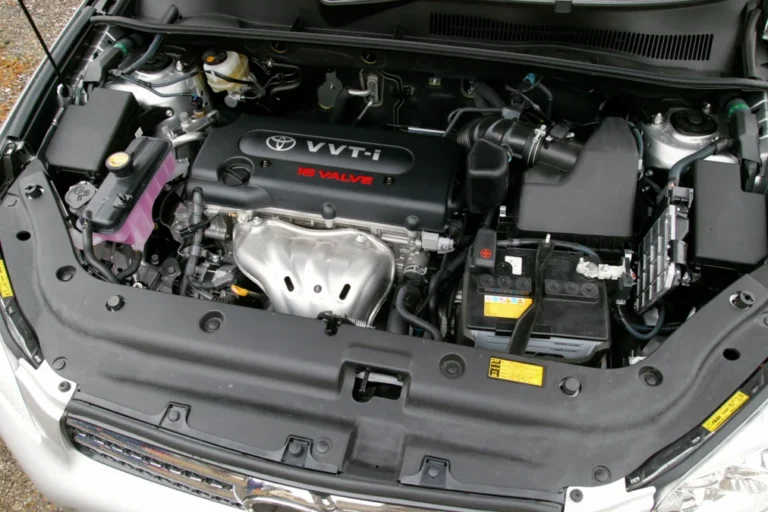
NRMA Motoring and Services, CC BY 2.0. Cover photograph via Wikimedia Commons, under CC BY 2.0. Lightly brightened and cropped. Australian-market engine-bay context. The actual vehicle requires its own diagnosis and applicability check. Component photograph by Amakuha, via Wikimedia Commons, under CC BY-SA 4.0. Cropped and resized. The adapted component image remains available under CC BY-SA 4.0. The diagnostic diagram is an original explanation of the bulletin’s branches.