Quick Answer
Kia Soul P0016 after engine replacement deserves a check of the camshaft pulse wheel when the fault was absent before the job. Kia PS731 identifies incorrect wheel positioning as one possible cause on its listed Soul engines. Establish the engine’s correct top-dead-center position, identify the wheel type and compare its reference edge with the manufacturer’s illustration. Do not rotate the wheel or replace a sensor from the code alone.
If a replacement engine runs but the warning lamp comes on, a workshop may check the timing again and still see P0016 or P0017. Before repeating the same repair, separate two questions: is the valve timing correct, and is the camshaft’s signal wheel presenting the correct reference to the sensor?
This is a sourced technical explanation, not a recorded customer repair. It explains the inspection decision in Kia PS731; the actual vehicle must be checked against current Kia service information.
First ask: were the codes present before the engine change?
Keep the pre-repair scan beside the new scan. A fault that first appears after replacement makes configuration and assembly checks especially relevant. If the code was already present, that timeline does not establish the replacement engine as the cause.
Kia PS731 addresses P0011, P0014, P0016 and P0017 after engine replacement on its listed applications. A matching code is a reason to check applicability, not a diagnosis by itself. Save the complete scan report, rather than writing only “timing code.”
What does the pulse wheel do?
The pulse wheel, also called a reluctor wheel, provides the camshaft position reference used by the control system. Its angular position matters. A wheel that is incorrectly positioned can produce the wrong reference even though it is still attached to the camshaft.
That explains why a sensor-related or correlation complaint should not automatically become a sensor order. The workshop needs to establish what the sensor is reading as well as check the electrical side under the vehicle’s diagnostic procedure. Likewise, the pulse-wheel check does not replace a mechanical timing check.
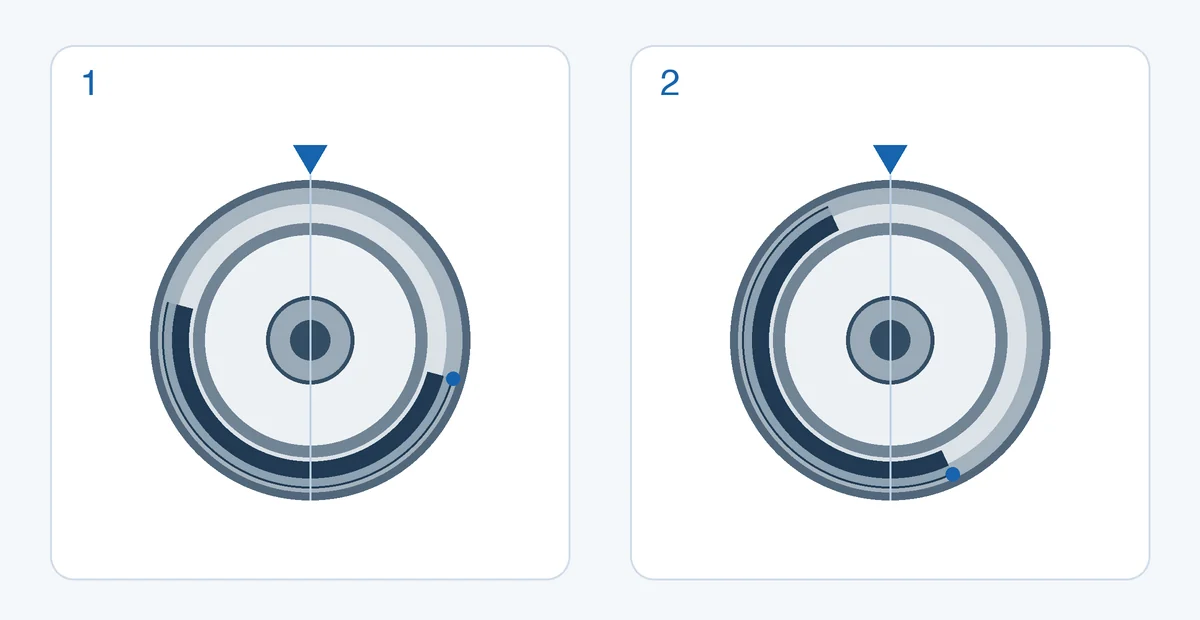
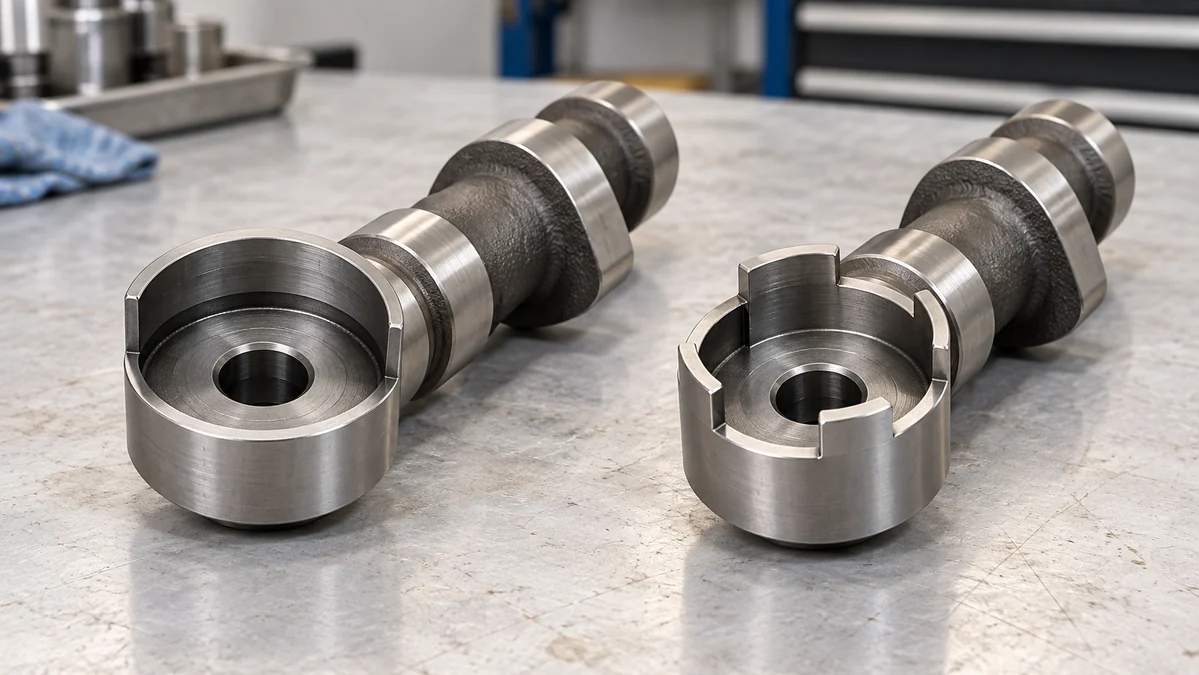
The diagram shows the same asymmetric target in two angular positions relative to a fixed blue reference. The shape is unchanged, but its edge moves. Neither position is presented as correct for a Kia engine. Use the actual photographs in Kia PS731 for the vehicle-specific alignment comparison.
Identify the wheel type before comparing its position
The bulletin distinguishes a two-flank, or half-moon, type from a four-flank, or castle, type. They use different visual references. A photograph of one type cannot establish the correct position of the other.
A useful inspection sequence
- Confirm the application. Record the VIN, market, model year and engine family. Do not select a reference solely because the vehicle is called Soul.
- Preserve the repair timeline. Record the previous codes and the first scan after replacement. Identify whether the camshafts or related parts were supplied or transferred.
- Establish the engine reference position. The bulletin’s visual comparisons require top dead center (TDC). This is a defined engine position, not whichever position happened to be visible when the cover was removed. Follow the exact engine’s service instructions.
- Identify the wheel type. Use a clear end view and retain an orientation photo. Then select the matching reference in the bulletin.
- Record the comparison. Show the specified edge and its corresponding engine reference together in the photograph. A close-up of the wheel alone cannot establish their relationship.
- Decide from the result. A confirmed mismatch supports the bulletin’s positioning concern. If the comparison is correct or inconclusive, continue the applicable diagnostic process rather than forcing a pulse-wheel explanation.
For the two-flank example, PS731 compares a wheel edge with a camshaft-cap bolt indentation. For the four-flank example, it uses the specified flank edge and the top of the camshaft. These are distinct references; use the original figures to identify them. This article supplies no force, adjustment angle or improvised method for moving the wheel.
Which Soul engines are listed?
PS731 covers specified Soul AM, PS and SK3 applications across the Beta 2.0L, Gamma 1.6L/1.6L GDI and Nu 2.0L GDI/MPI families. The model-year and engine pairings are listed on page 1 of the bulletin. Match the actual vehicle to that list and current Kia information; this is not a blanket application claim for every Soul or every engine from those families.
Use the engine identification guide to prepare the identifiers. If the engine configuration differs from the original, retain both the original-unit photos and the replacement-unit records. Do not infer compatibility from a similar-looking cylinder head.
What should the workshop’s conclusion say?
A usable conclusion identifies the engine, wheel type, reference position and observed alignment. It should state whether a mismatch was confirmed, ruled out or left unresolved. Keep the corresponding photograph with the scan report.
After any authorized correction, record the post-repair diagnostic result under the applicable service procedure. Clearing the warning lamp alone does not document why it appeared or whether the repair addressed it.
For the wider job, the installation preparation guide helps keep transferred components and responsibilities visible. That general preparation is separate from the specific pulse-wheel inspection described here.
NANXI POWER: matching the engine inquiry to the installation
NANXI POWER can help review the engine code, VIN and original-engine photos, clarify the requested configuration, and provide pre-shipment visual records. Include the workshop’s scan report and identify camshaft-related components intended for reuse. The accessory configuration guide helps describe that scope. Diagnosis and approval of the installed components remain with the workshop.
Manufacturer reference
Kia PS731, May 2022: camshaft reluctor-wheel configuration. The saved publication may be superseded; use current KGIS service information for repair work. The illustration is original educational artwork, not a Kia part photograph, installation guide or repair record.
Send the engine and workshop details
Include the VIN, engine code, original-engine photos, diagnostic findings, required assembly, reused components, quantity and delivery country.